

3D Modeling Life 2026: Strong Demand, High Scientific Value, and Clear Momentum for 3D Human-Based Technologies
- FRESCI TEAM
- Mar 18
- 5 min read

Updated: Mar 20
More than a successful symposium, 3D Modeling Life 2026 sent a clear signal: the biomedical ecosystem is actively seeking more predictive, human-relevant models and more strategic dialogue on how to translate them into research and innovation practice.
Held on 18–19 February 2026 at Sapienza University of Rome, Modeling Life 2026 – 3D Human-Based Technologies in Modern Biology brought together academic, industrial, and public-sector stakeholders around one central question: how do we accelerate the adoption of advanced human-based 3D systems in modern biomedical research? The event was organized by Dr. Giulia Matusali, Dr. Nadia Andrea Andreani, Dr. Martina Pasqua, and Dr. Marco Straccia, with Sapienza as host and FRESCI among the key organizing and sponsoring actors.
What makes this edition especially notable is not only the strength of the scientific program, but the level of demand it generated. According to the organizing team, the symposium received more than 2,000 attendee requests, far beyond the available capacity. Participation therefore had to be limited, despite demand exceeding expectations. That over-subscription is strategically important: it points to growing interest at both national and international level in organoids, organ-on-chip systems, advanced cell culture platforms, and broader human-based translational technologies.
Why this event mattered
The event was positioned as a two-day hybrid scientific symposium designed to promote the adoption of 3D human-based models for more predictive and decision-oriented biomedical research. The target audience explicitly included PhD researchers, principal investigators, research structures, translational R&D teams in pharma, biotech and medtech, CROs, technology providers, and stakeholders interested in evidence frameworks and standardization of New Approach Methodologies.
That framing matters. Too often, the conversation around advanced in vitro systems stays fragmented between scientific novelty, technology promotion, and policy ambition. Modeling Life 2026 did the opposite: it created a platform where biological complexity, translational relevance, industrial applicability, and standardization pathways were discussed in one place.
A program designed around translational relevance
The scientific architecture of the symposium reflected both breadth and depth. Across the two days, the program covered nervous system, lung, bone, gastrointestinal, endocrine, reproductive, and immune system models, alongside a dedicated session on data-driven innovation.
The opening lecture was delivered by Dr. Milena Mennecozzi from the Joint Research Centre of the European Commission, focusing on standards for emerging human-based technologies and the role of the European Commission. This was followed by talks spanning ALS neuromuscular organoids, airway inflammation organ-on-chip models, gastrointestinal organoids, endocrine 3D systems, vaccine-response models, and immune-relevant organoid research. The event closed with Prof. Thomas Hartung of Johns Hopkins Bloomberg School of Public Health, speaking on the use of brain organoids in life sciences.
For FRESCI, the agenda was especially aligned with our strategic positioning at the interface of science, translation, and innovation intelligence. On Day 2, Dr. Marco Straccia presented BimmoH.eu, described in the program as the largest AI-powered database for human-based models in biomedical research by the European Commission, and later led the student workshop “The Right Model for the Right Question: Research Strategy for PhDs to Maximize Translational Value.”
Feedback confirms strong scientific positioning
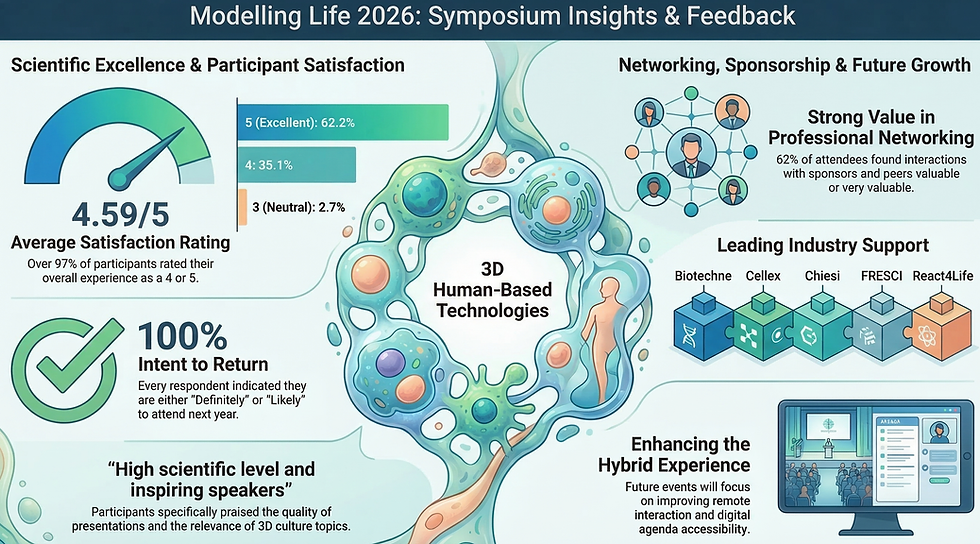
The post-event survey shows that the symposium did not just attract interest; it delivered a strong participant experience. Among 37 responses, the event achieved an average overall rating of 4.59/5. More than 97% of respondents rated the event 4 or 5, and 100% said they were either “Definitely” or “Likely” to attend the next edition.
The qualitative feedback is equally telling. Participants highlighted the “high scientific level,” the quality of presentations, the relevance and significance of the topics addressed, and the broad range of scientific applicationsof emerging technologies for increasing the complexity and utility of in vitro studies. One respondent specifically valued the inclusion of academics, companies, and people involved in policymaking and translation, underscoring the symposium’s success in bridging silos that are too often kept apart.
This is precisely the kind of signal that matters for the future of the field. High satisfaction is good. But high satisfaction around a program that deliberately combines science, translation, standards, industry, and policy is more than good event performance; it suggests that the market is ready for more integrated formats and more mature conversations around adoption.
The ecosystem dimension was a differentiator
Modeling Life 2026 also benefited from a deliberately multi-actor configuration. The program and event materials identify Bio-Techne, Cellex, Chiesi, FRESCI, and React4Life as platinum sponsors/strategic industry partners, with Sapienza University of Rome, SIMGBM, and Istituto Pasteur Italia among the institutional supporters and partners.
That ecosystem composition is not secondary. Human-based 3D technologies will not scale through scientific excellence alone. Their wider impact depends on coordinated progress across method development, platform engineering, industrial uptake, qualification readiness, translational strategy, and evidence standardization. Events like Modeling Life 2026 are valuable because they create exactly this type of interface.
What the results also tell us: scale and hybrid delivery now matter
The survey also surfaced clear operational opportunities for future editions. Some participants asked for greater audience capacity, stronger remote interaction, more structured networking time, and broader access to materials such as presentations or certificates. Several comments indicate that online participants wanted a better mechanism to ask questions and engage in discussion, while others pointed to demand for poster sessions or deeper networking with sponsors and experts.
This is not a weakness in the broader narrative. It is evidence of success meeting scale constraints. When an event draws this level of attention and receives this level of engagement, the next strategic step is obvious: expand the format, optimize the hybrid experience, and design more deliberate interaction pathways across in-person and online audiences.
FRESCI’s perspective
At FRESCI, we see Modeling Life 2026 as part of a larger structural shift. The scientific and translational community is moving beyond the question of whether advanced human-based models matter. The real questions are now more operational:
How do we choose the right model for the right question?How do we connect scientific sophistication with decision-grade evidence?How do we integrate academic, industrial, and regulatory perspectives early enough to accelerate uptake?And how do we build the intelligence infrastructure needed to navigate a rapidly expanding technology landscape?
These are exactly the kinds of questions that FRESCI works on across biomedical research, translational strategy, AI-enabled evidence ecosystems, and innovation partnerships.
Looking ahead
Modeling Life 2026 demonstrated three things clearly.
First, demand for high-quality dialogue around 3D human-based technologies is growing fast.Second, the community values not only scientific depth, but also translational and cross-sector relevance.Third, the next phase will require scale: more access, better hybrid delivery, and continued ecosystem building.
For everyone working in NAMs, organoids, organ-on-chip, translational R&D, biomedical strategy, or evidence innovation, the message is straightforward: this field is accelerating, and the appetite for practical, high-value exchange is real.
FRESCI is proud to have contributed to an event that helped move that agenda forward.


Comments